Showing posts with label Boston. Show all posts

Wednesday, August 1, 2012

Permaculture and Summer Social

Hello Readers,

I have not had too much time to prepare a post for today, but I thought you might be interested in two things:

For those of you who were following the MBTA Series and live in Boston: tomorrow (Thursday, August 2nd, 2012) there is a Summer Social hosted by Livable Streets at the BSA Space.
Event Details
Thursday, August 2, 5:30-7:30pm
At the BSA Space
290 Congress Street, Boston
Free and open to the public
The BSA (or Boston Society of Architects) is providing the space, and visitors can check out their current exhibit "Let's Talk About Bikes."

For those of you not living in Boston, I have found a thorough article explaining what Permaculture is: Taking the Permaculture Path to Community Resilience, which should be interesting for any aspiring sustainable community planners who want to take their calling to the next level!

Welcome to August!

~Sean

Friday, July 27, 2012

Proposal: Reducing the MBTA Debt (Part 3)

Hello Readers,

Earlier in this series, I provided some background on the MBTA debt crisis and offered some justification for introducing a Parking Space Tax (PST) as part of a comprehensive transportation policy for the greater Boston metro area. I also suggested that any possible solution to the MBTA debt crisis must meet three criteria: (1) effectively addressing the debt itself (rather than merely shuffling it around), (2) improving the overall commuter experience, and (3) increasing MBTA revenues without unfairly burdening individual riders through constantly increasing fares.

In this final post in the series, I will offer some specific stipulations and suggestions regarding the structure and scope of any PST introduced in Massachusetts. I offer each of these recommendations with the hope that they ensure that the financial burden of the PST is spread equitably and that the corollary transportation incentives of the PST are targeted effectively.

PST Considerations

First and foremost, I feel compelled to acknowledge that there are many legitimate uses of cars and that as a result there is some legitimate need for parking spaces. Growing up in suburban Pennsylvania, I experienced innumerable situations where attempting to use any other form of transportation would have been simply impractical. I can only assume that in Massachusetts there are analogous issues that must be considered. With this concession in mind, here are some principles worth considering:
  1. Handicap Access - No matter how many elevators, ramps, and kneeling buses a mass transit system may introduce, there will be instances where forcing handicapped individuals not to drive (or have access to parking) will put an unreasonable burden on those individuals and their families. Thus, I recommend any PST or similar program waive all fees, costs, and limitations related to handicap parking spaces.

  2. Population Density - That is to say that in areas with especially low population densities, a mass transit system may not be a viable option. In some situations, a rural population may only have enough people traveling to a shopping center each day to fill a bus three times per day. Of course, only having access to the shopping center three times per day or running a half-filled bus six times per day would not be helpful for the shopping center businesses, convenient for the local residents, or economical for a bus company or transit authority. In these areas, personal cars and parking spaces truly are the best option.

    At the same time, there are numerous suburban and urban areas where personal cars may seem like a necessity. However, this perceived necessity is typically much greater than the actual utility of personal cars. Specifically, by improving current transportation alternatives or introducing new alternatives, the local population could easily and effectively make (better) use of a mass transit system to the benefit of commuters as well as local residents and businesses.

    Thus, understanding the relationship between population density and the utility of personal car use, I strongly urge that any PST or similar program be directly correlated with population density, such that areas with higher population densities bare a larger burden than areas with lower population densities. In fact, areas with sufficiently low population densities should not bare any PST or mass transit burden.

  3. Free over Fare - While there may be no right to parking, I would contend that there is a right to free travel. That is, no matter how rich or poor someone is, they should never be trapped by the cost of transportation or overwhelmingly obstructed by the infrastructure of non-free transportation (i.e. no mode of transportation that costs money should prevent someone from using free modes of transportation).

    Despite how beneficial cars, subways, buses, or any other mode of transportation may be, it should not trump the needs of cyclists and pedestrians. On the contrary, improvements to fare-based transportation should only serve to augment the ability of people looking to walk or bike to their destination. Thus, bike racks, bike lanes, wider sidewalks, and benches should all be considered alternatives to parking spaces, and in related policies the introduction of new free-travel improvements should be an opportunity to reduce a community's PST burden.

  4. Validated Parking - Often urban shopping centers, entertainment venues, and groceries stores 'validate parking' to alleviate the burden of the cost of parking for their customers. I would like to reconsider this concept in two ways in order to address some potential criticisms of a PST.

    Rather than validating parking in densely populated neighborhoods and towns, why don't stores 'validate' mass transit costs? Stores with parking lots or garages might easily charge a dollar or more per hour for parking, because in these cases, the stores have spent (or are spending) money to build or maintain the parking spaces, a cost that could be passed on to customers directly. However, they realize that it is beneficial to their bottom-line to subsidize this parking cost for customers that may be spending hundreds of dollars during a shopping trip. Wouldn't it make as much sense (or more sense) for those stores to validate mass transit fares instead and fore-go the expense of maintaining a parking lot or garage? Just imagine if for every $20 you spent on groceries, you could have a quarter added to your Charlie Card!

    On the other hand, many people live in the city where mass transit exists but work in the suburbs and country side in massive office complexes, which are not accessible (or barely accessible) via public transportation and are well out of the range of an average cyclist. In these cases, someone's livelihood may depend on their ability to have access to a car for their daily commute, which may mean that a hefty PST at home needs to be paid solely so they can get to work. As such, it would be entirely feasible for employers (especially large corporate employers), who have decided to locate their operations in a suburban locations, to validate their employee's residential parking costs. This may seem outlandish at first, but consider that many urban employers already offer similar commuter benefits to encourage their employees to utilize mass transit services.

  5. Other Concerns - While I do not have a catchy name for this point, I would discourage any stipulations that taxed the use of private driveways at residences. Part of my justification for PST legitimacy is the over-use of public spaces, which admittedly has been stretched somewhat to include commercial spaces, as parking spaces. However, it seems inappropriate to try to assess parking taxes on farms or private residences. The purpose of the PST is not to make car ownership impossible, it is only to discourage excessive car use and encourage alternative forms of transportation whenever appropriate. Thus, I would also consider making provisions for car share programs, taxis, parking spaces at commuter rail stations, and even car dealerships and some long-term vehicle storage facilities.
One Possible PST Structure

One way to structure a PST would include calculating the rate of taxation at the municipal level on a per parking space basis, which is scaled to the local population density. For example, the tax could be designed such that the PST rate in each municipality is equal to $0.01 per day for each taxable parking space, multiplied by the local population density divided by 1000. In this calculation, a municipality's population density would be rounded down to the nearest thousand. The tax rates for the most densely populated municipalities in Massachusetts under such a scenario are listed in the box below.


MunicipalityPop. Density
Per Sq. Mi.
Daily PST Rate
Per Parking Space
Annual PST Cost
per Parking Space
Somerville18,448$0.18$65.70
Cambridge16,358$0.16$58.40
Chelsea16,081$0.16$58.40
Boston12,753$0.12$43.80
Everett12,314$0.12$43.80
Malden11,716$0.11$40.15
Lawrence10,974$0.10$36.50
Winthrop8,803$0.08$29.20
Revere8,750$0.08$29.20
Brookline8,649$0.08$29.20
Population density figures based on 2010 census data posted on the arlington-mass.com website.

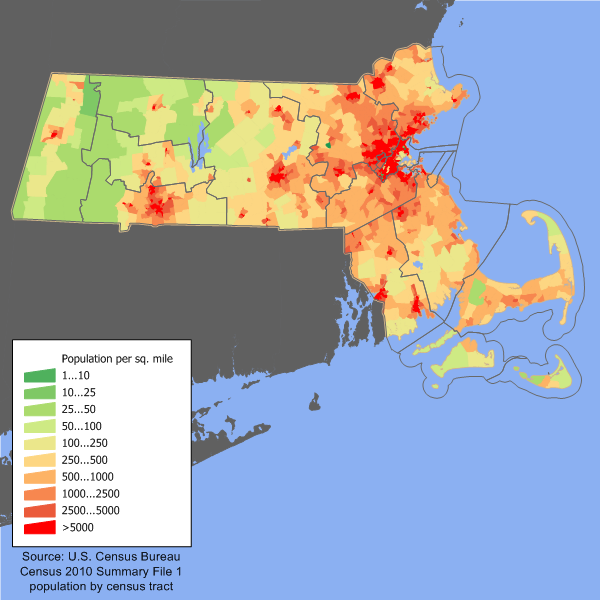
Each of the municipalities listed in the table above are already served in some way by the MBTA and would most greatly benefit from improvements to T service. Of course, there are some densely populated areas that are not served by the MBTA, see the map below. However, each of these areas could probably make use of some mass transit funding in the future. Furthermore, as you may note in the map below, there are also large regions of the state with population densities below 1,000 residents per square mile, which would not be subject to any PST rate at all.


Of course, as every urban planner and policymaker knows, every location is different. With this in mind, I will suggest that a state-wide PST follow the guidelines listed in the above section and establish a rate structure similar to the one in this section. Then, as long as the related legislation clearly defines what is and is not considered a taxable parking space, the actual administration and collection of the PST may be left up to the municipal authorities (with some small percentage of the revenues being returned to the municipalities to cover their administrative costs).

This will offer municipalities and local residents the ability to determine how to divide up the financial burden of the PST and develop innovative ways of reducing the number of parking spaces in their own municipality - while still meeting the needs of citizens and businesses. For example one town may decide to collect the revenues through residential parking permit fees, whereas another may elect to put the burden on commercial properties by increasing real estate taxes or charging a parking lot fee. Likewise, some municipalities may decide to erect new no-parking signs on certain streets, replace parking spaces with bike racks, or allow restaurants to block off old parking spaces for use as outdoor seating.

In any event, implementing a Parking Space Tax will involve a little bit of creativity. However, if done right, it can meet the three criteria necessary to solve the MBTA debt crisis and offer a sustainable alternative to the current de facto transportation policy in Massachusetts.

Sincerely,

Sean Diamond


Wednesday, July 25, 2012

Proposal: Reducing the MBTA Debt (Part 2)

Hello Readers,

In an earlier post, I introduced the issue of the overwhelming debt that is burdening Boston's mass transit system, the MBTA. In that post, I also suggested that a Parking Space Tax (PST) is a possible solution that will meet three criteria: (1) effectively addressing the debt itself (rather than merely shuffling it around), (2) improving the overall commuter experience, and (3) increasing MBTA revenues without unfairly burdening individual riders through constantly increasing fares.

In this post, I shall offer justification for taxing parking spaces as a means of meeting these three criteria. In the next post, I shall suggest some features and stipulations of a PST that ensure its equity and effectiveness as a part of a comprehensive transportation policy.

The Right to Parking

I recently watched the documentary Urbanized, a film directed by Gary Hustwit about urban planning. In the film, the former mayor of Bogota, Columbia (Enrique PeƱalosa) drove home a point that stuck with me. He asked, essentially, where in the [Columbian] constitution is there a right to parking? Obviously, the answer is that there is no 'right to parking' in any constitution in the world, that a 'right to parking' does not exist. He also went on to suggest that in a democracy that it is the people who should be treated equally, not the cars. Thus, a bus that holds 50 people should have 50 times more priority and access to a roadway than a car that holds 1 person.

Building on the concept that there is no 'right to parking' (and preferring people's equity rather than cars' equity), I would like to suggest that parking is indeed a privilege and not a right. Furthermore, the existence of on-street parking spaces and public/commercial parking lots and garages (and the associated side effects of their existence) tend to put a significant burden on the public as a whole. Therefore, parking spaces should be subject to a tax.

Some Burdens of Parking Spaces on the Public
  1. Physical Space - The most obvious and direct impact of parking spaces and parking lots is that their physical presence prevents the allocation of that space for other uses. Just imagine if every building in Boston had an additional 9' wide patch of green space in front of it or if restaurants and cafes could provide ample outdoor seating without obstructing the sidewalk! Likewise, consider what might be possible if the neighborhood grocery store had half of its parking spaces replaced with parks that included community gardens, bike racks, or even a public pool or ice rink.

    Instead, massive parking lots and on-street parking take up a lot of space. If on-street spaces were privately owned, you can be sure that the landlords would be charging rent for that space. However, since many parking spaces are publicly owned, car owners can use them rent free or nearly rent free.

    Even metered parking spaces are 'rented' at rates that are low compared to the surrounding land. For example in the City of Boston, a metered parking space is charged at a rate of $1.25 per hour. For each space, this works out to a maximum of $4,692.85 per year or just over $390 per month (after considering there is no charge on Sundays and at night) for a 216 square foot space (or roughly the size of a modest studio apartment). In other words, these spaces have a maximum financial return to the public of <$22/sq. ft each year, even in areas that may have a land values of over $200/sq. ft, which pay a property tax of well over 10%!

  2. Increased Congestion - For decades, policymakers have been attempting to address congestion and traffic by adding lanes to highways and streets. During each of those same decades, congestion has continued to get worse (or at the very least not better) in most places. Why is this?

    The reasoning is that adding traffic lanes provides more opportunities for cars to pass one another. The counter-intuitive result is that more people are encouraged to drive more often rather than using other modes of transportation. In effect, adding lanes of traffic to roads makes other modes of transportation seem more dangerous (e.g. by increasing the curb-to-curb distance for pedestrians and forcing cyclists to cross multiple lanes of traffic to turn left from a bike lane) and more difficult (e.g. putting obstructions and vehicles between places that are physically close together), which encourages more people to drive - causing more congestion.

    However, it is not simply the additional traffic lanes (or increased danger for alternative transportation methods) that significantly affect congestion. Instead, it is the availability of parking spaces at the end of the journey.

    Consider, for a moment, if there were zero parking spaces available in Boston. How many people would drive into Boston? Basically none. Granted, there would still be some traffic through the city, and perhaps occasionally someone might drop off a friend and return without needing to park. Yet, this would certainly amount to very little congestion compared to the daily rush hour in Boston today.

    Now, consider a less extreme case, where there were simply fewer parking spaces and those that were available were a little more expensive or otherwise reserved for handicapped citizens, car share programs, and bike racks. While driving would still be an option, it would probably be reserved for special occasions. Theoretically, such a scenario would decrease congestion. Thus, conversely, allowing parking spaces to be relatively cheaper and more available (the current situation) encourages more driving and more congestion than is necessary.

  3. Environmental Impacts - In my mind, the environmental impacts associated with parking spaces are relatively obvious even if they are somewhat indirect, so I will not dedicate too much discussion to this burden. Most directly, paved parking spaces cause increased storm-water runoff, compared to an equal amount of green space. Additionally, the vehicles parked on the spaces leak and leach fluids and oils that are often swept away with the storm-water into the rivers and harbors in Boston. Finally, as a corollary, all of the increased congestion related to parking spaces (as described above) means that each vehicle is spewing more pollutants per mile traveled.
So far, I have only discussed the issues and problems related to parking spaces and commuting by car. In the next post, I shall make a few concessions regarding the benefits of cars and parking spaces, as I offer some recommendations about the structure and limitations of any Parking Space Tax that may be introduced in Massachusetts.

Sincerely,

Sean Diamond


Monday, July 23, 2012

Proposal: Reducing the MBTA Debt (Part 1)

Hello Readers,

Earlier this summer I moved to the Boston area and began to search for local sustainably minded organizations and investigate the local sustainability issues. As I did so, I quickly ran into one issue in particular that seems to be on everyone's mind: the MBTA.

For anyone not living in Massachusetts, the MBTA stands for Massachusetts Bay Transportation Authority, which is the entity responsible for operating all commuter and mass transit services in the greater Boston metropolitan area, including local buses, ferries, subway lines, and commuter rail lines. According to the MBTA website (and the 2010 US Census), the MBTA services a territory with a population of 4,817,014 in a state with a population of 6,547,629 (i.e. nearly 75% of the population of Massachusetts). Though most often used in reference specifically to the subway system, the MBTA is commonly known as simply as the T.

The Issue

Unfortunately, from what I can surmise based on my discussions with people and searching through recent news articles, the MBTA is deeply in debt. So far in debt in fact that according to a BostInno article by Denise Provost, "Payment of interest on its debt eats up over 30 percent of MBTA’s entire budget."

According to an online Boston Magazine article, the total debt (at least as of February 2012) is $5.2 billion, which is attributable to three sources:
  • $1.85 billion - debt from MBTA improvement projects since 2000
  • $1.65 billion - debt from MBTA improvement projects prior to 2000
  • $1.7 billion - debt from the 'Big Dig' project
To explain the reasoning behind this breakdown, a little bit of modern history is required.

In 2000, the state legislature restructured the MBTA, requiring it to annually balance its budget under a so-called "Forward Funding" scheme. As part of the scheme, the MBTA was required to payback debts that the state had previously incurred due to MBTA maintenance and improvement projects. The scheme also required the MBTA to take on debt related to the environmental mitigation projects related to the Big Dig.

The Big Dig is the unofficial name of a now infamous highway project in Boston that was designed to re-route I-90 and I-93 through underground tunnels as they passed through downtown Boston. As part of the environmental mitigation for the massive amount of environmental disturbance that the Big Dig would cause, the state legislature agreed to implement several upgrades to the T system. The highway construction of the Big Dig took nearly a decade longer than expected and the actual cost was billions of dollars over-budget.

For an extensive overview of how the MBTA got so far into debt, see the 2009 MBTA Advisory Board report (pdf).

The Proposed Solution

The default response to this issue by the MBTA has been to raise fares and/or cut back on services: the two aspects of its budget over which the Advisory Board has control. Of course, both of these responses discourage T ridership by making mass transit trips more expensive and less convenient. Simultaneously, this makes other forms of commuting such as driving relatively more attractive, and it puts an additional burden on those most reliant on the T as their only means of transportation.

I have found many other potential solutions floating around on the internet, including absurd suggestions like selling liquor on subway cars to more serious suggestions. For example, the 2009 MBTA Advisory Board report recommended that the state simply take back the debt from the MBTA and put it back on the state budget. Also, one proposal currently on the table would require selling the naming rights to the busiest stations, but it would only make $147 million dollars over 8 years (less than one fifth of the annual budget deficit - note not the whole annual budget, just the deficit).

However, I cannot find any suggestions (at least none with any significant description) that include: (1) effectively addressing the debt itself (rather than merely shuffling it around), (2) improving the overall commuter experience, and (3) increasing MBTA revenues without unfairly burdening individual riders through constantly increasing fares. Thus, I would like to propose a solution that may ruffle a lot of feathers but should fulfill all three of these criteria and be relatively straight forward to implement.

The proposed solution is this: a Parking Space Tax.

Now, Republicans and Libertarians please hear me out before stonewalling the very notion of a tax. I could have very easily tried to call it a 'service fee' or something else, but I shall call it what it is. The Parking Space Tax (or hereafter PST) will have some features and stipulations that I will describe in a later post. However, in the next post, I will explain my reasoning behind a policy connecting parking and mass transit.

Also, while you are waiting for the next post in the series, you can take a look at a related Boston Globe article that was published as I was editing this series. The article is actually based on a similar premise but has a limited focus: downtown parking garages.

Sincerely,

Sean Diamond